

This is dust.

You’ve seen it your whole life. Floating in a sunbeam, collecting on a shelf, getting swept under a couch. It feels like the most harmless thing in the world.
But it’s not harmless.
Researchers sampled household dust and found pesticides, flame retardants, forever chemicals, plasticizers, and known carcinogens. 258 chemicals in total, many showing up in over 50% of the homes tested.
And that’s just what’s in the dust.
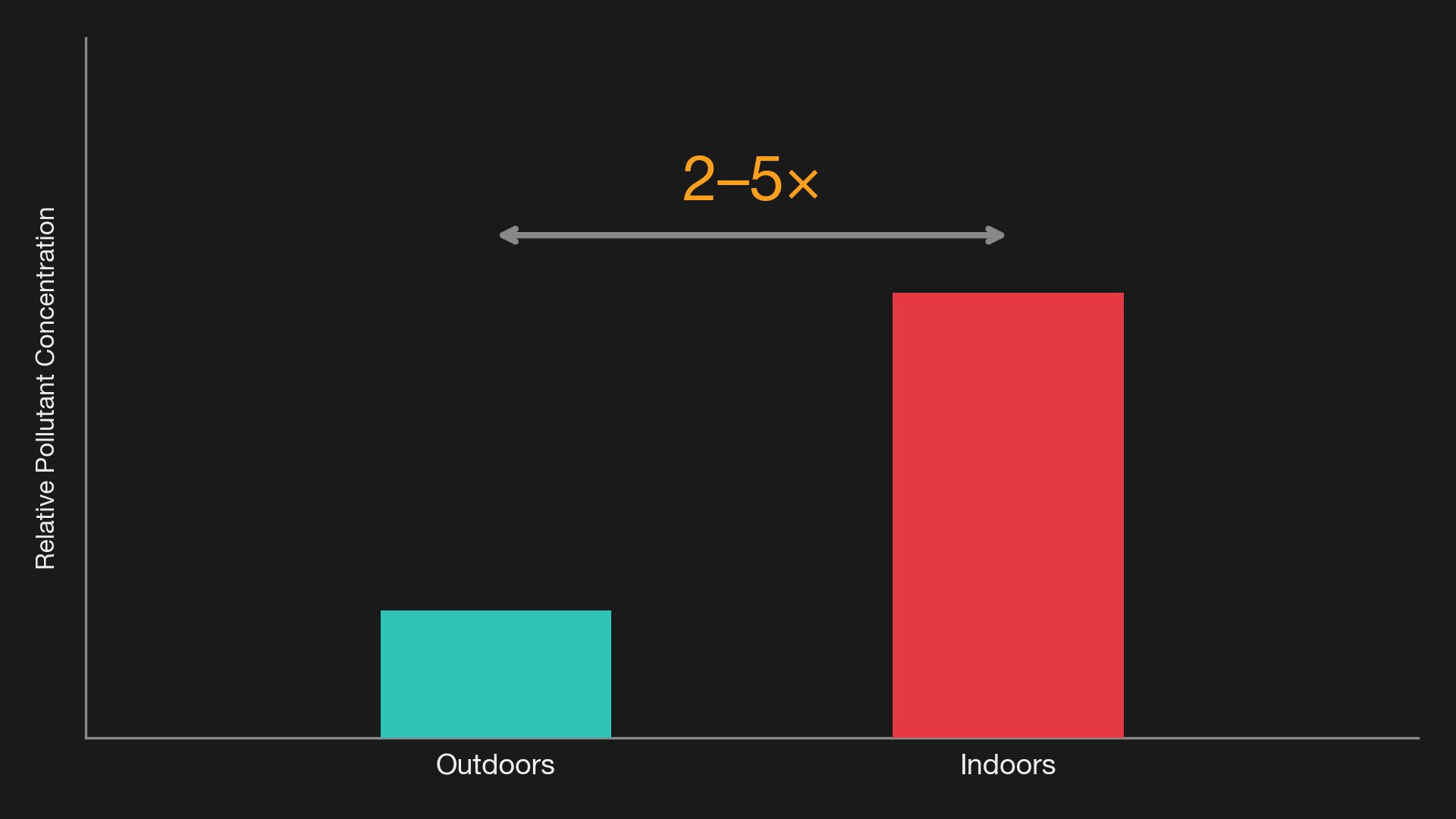
We spend 90% of our time indoors, where pollutant concentrations are often 2 to 5 times higher than outdoors.
We sleep on mattresses releasing chemicals linked to cancer and reproductive harm. We drink and shower in water contaminated with chemicals that weaken our immune systems and alter metabolism. We use personal care products that disrupt our hormones and are linked to cancer. We clean our homes with products that trigger asthma and damage our lungs.
And our kids crawl across floors, hands in their mouths, absorbing all of it faster than any adult would. But it doesn’t have to be this way.
We have the technology and collective knowledge to make our homes genuinely good for us. Spaces that support human health instead of quietly working against us.
So why isn’t this the norm? Why are our homes silently poisoning us?
A broken information system
Nobody wants these chemicals in their home. But when you’re buying shampoo, you can’t see the benzene. When you’re picking out a sunscreen, you can’t smell the carcinogenic contaminant 1,4-dioxane. And you can’t taste the PFAS (aka forever chemicals) migrating from a nonstick pan into your eggs.
The chemistry is completely invisible to your senses.
And even if you try to figure out exactly what’s in a product, the system isn’t built to help you.
Take fragrance.
The fragrance industry operates under a “trade secret” exemption that lets manufacturers list “fragrance” on a label without listing out each ingredient put into the fragrance, concealing hundreds of potentially harmful compounds under a single word.
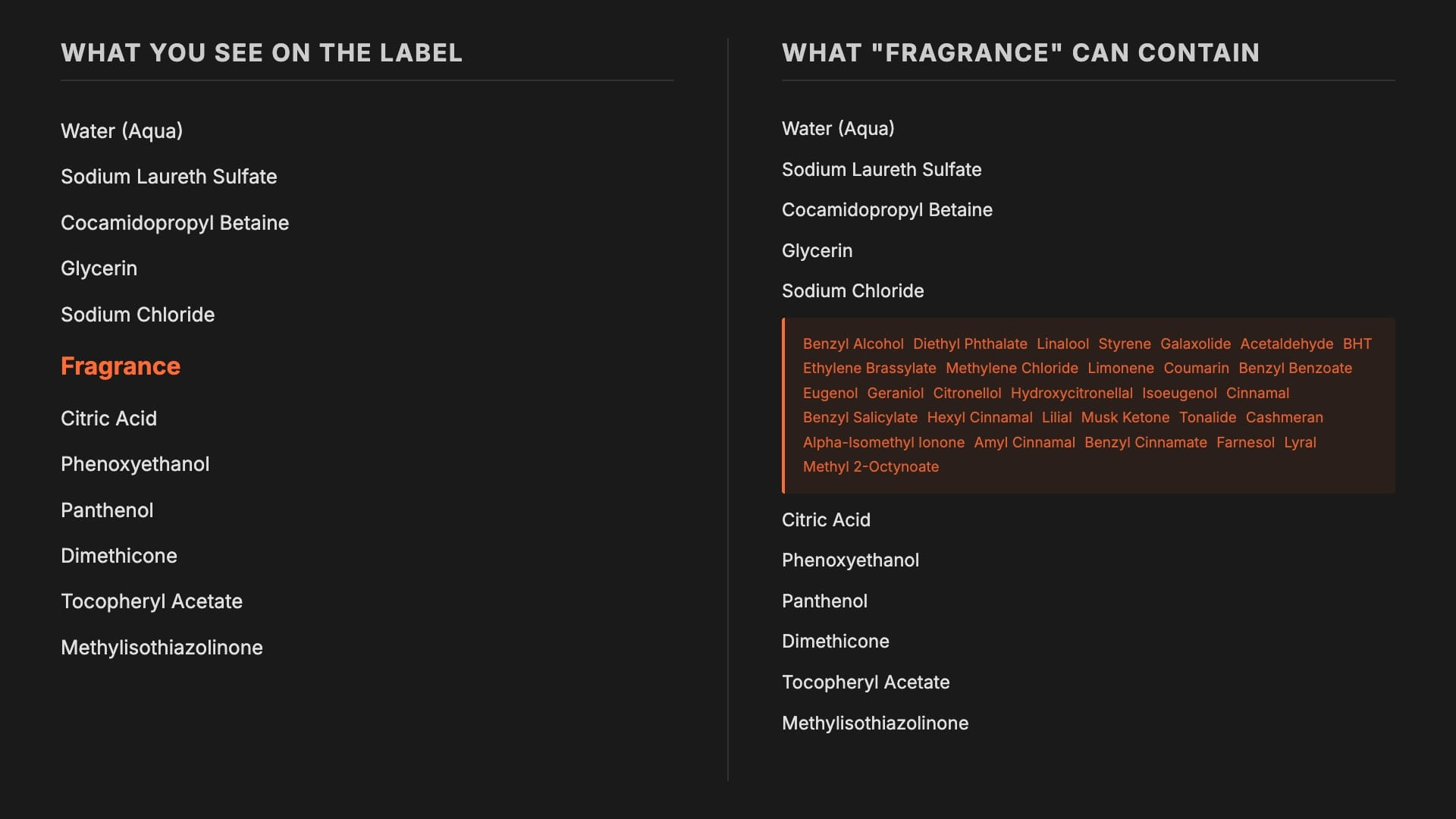
The companies producing these products know what goes into them, but the people purchasing them don’t. This is what economists call information asymmetry: one side of the transaction knows far more than the other.
George Akerlof described exactly this kind of failure in his famous Market for Lemons paper. He was writing about used cars, but the mechanism is identical: when buyers can’t tell the difference between a good product and a bad one, they treat everything the same. There’s no reason to pay more for quality you can’t verify. So quality collapses.
The companies that win aren’t the ones making the best products. They’re the ones that can make them the cheapest and get them on the most shelves.
You’ll often hear “vote with your wallet.” But you can’t vote intelligently when you don’t have the information to make an informed choice. The market is supposed to reward the best products and punish the worst, but it can’t do that when you’re buying blind.
The human cost
This isn’t just an economic inefficiency. There’s a human cost to a lack of information.
In the early 1900s, a radioactive substance called radium was popular. It was marketed as a “miracle substance” and companies put it in toothpaste, health drinks, even baby products. Nobody questioned it because it was so normalized.
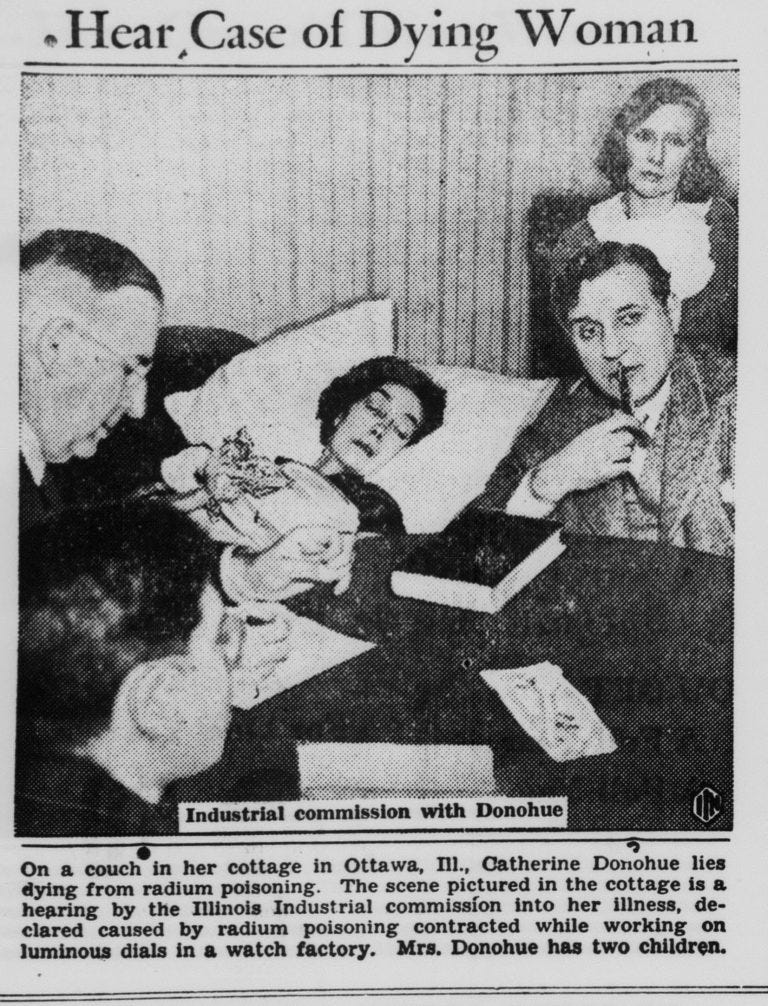
Young women were hired at factories to paint glow-in-the-dark numbers on watch faces using radium paint because of its luminescent properties. They were told to lick the tips of their brushes to keep a fine point. They did it hundreds of times a day, ingesting radium with every stroke. They were told it was safe.
The companies eventually discovered radium was dangerous. They had internal evidence for years but said nothing. When the women started getting sick and tried to fight back, the companies hired their own doctors to produce competing medical reports. They blamed the women’s symptoms on other causes. They dragged lawsuits out for years, knowing some of these women wouldn’t live long enough to see a verdict.
By the time the truth was undeniable, the women were dying. Their bones were deteriorating, jaws literally falling apart and many had advanced forms of cancer. The government eventually stepped in, but for most of these women, it was far too late.
Sometimes the information gap is created deliberately, like it was with radium. But more often, the science simply hasn’t caught up yet. Products go to market, people use them for years or decades, and the evidence of harm accumulates slowly after the fact.
Asbestos was used in homes for decades before anyone established it was killing people. Lead was in paint and gasoline for generations. Flame retardants were put in baby clothes. And right now, PFAS, chemicals linked to cancer and a whole host of other serious health problems, are showing up in the blood of 98% of Americans because it’s in our drinking water, cookware, furniture, and clothing.
Where are the safeguards?
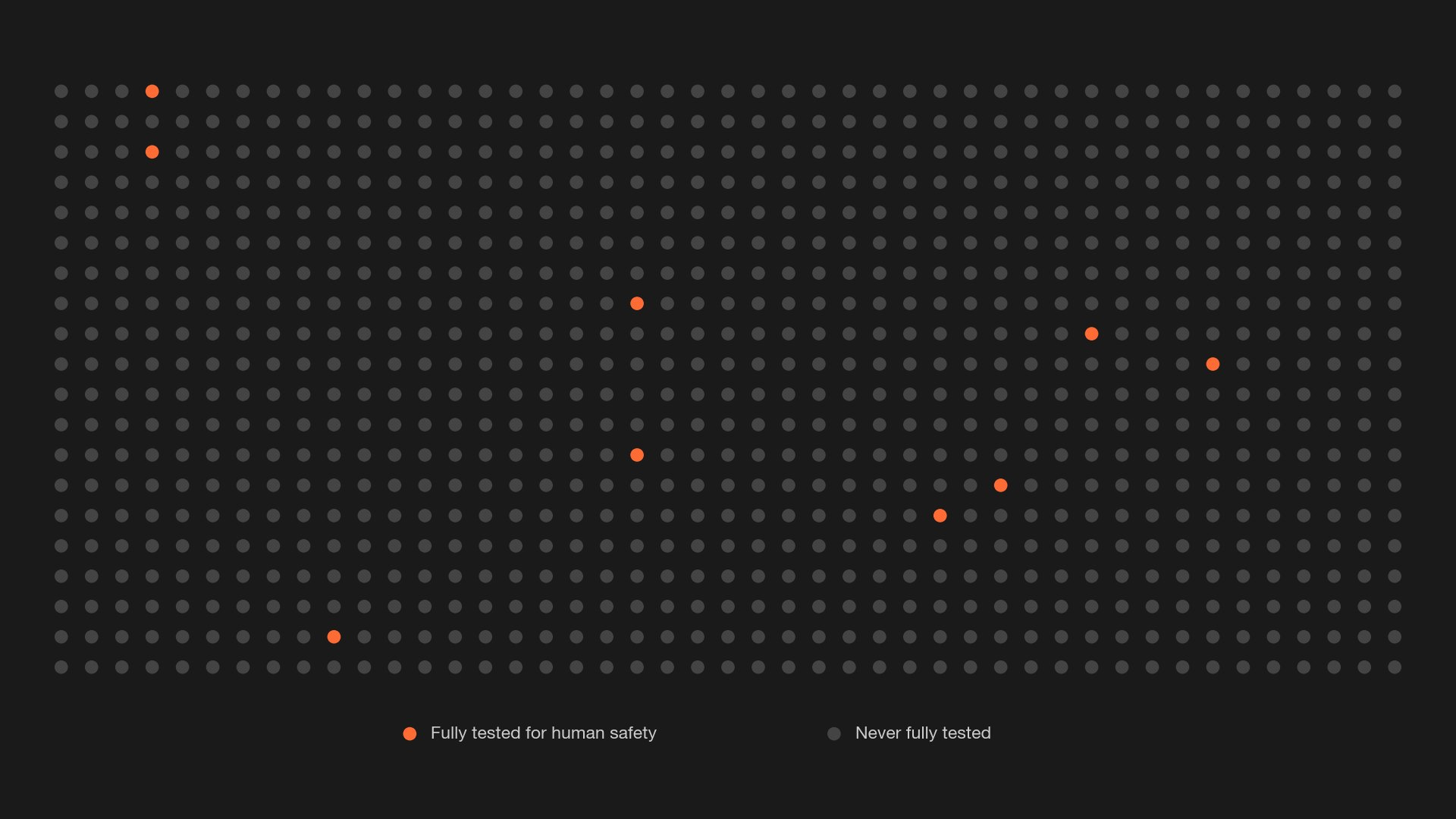
Tens of thousands of chemicals are registered for use in US commerce, but the vast majority have never been fully tested for human safety.
Cosmetics and personal care products aren’t subject to FDA premarket approval. Companies decide for themselves whether their ingredients are safe.
Mattresses face a similar gap. They’re regulated for fire safety, not chemical safety. The flame retardants used to pass flammability standards weren’t tested extensively for human health before they ended up in the mattress you sleep on every night.
Across the board, the standard is the same: products are assumed safe until proven otherwise. And proving otherwise usually takes decades.
What about science?
“Does this chemical cause harm in humans at everyday exposure levels?”
That question isn’t answered by a single study. It takes years, sometimes decades, of studies building on each other. One finds a signal which raises new questions for the next to answer. Each builds on the last, slowly narrowing the uncertainty until there’s enough evidence to say something definitive.
That’s not a flaw. That’s how good science works.
And it’s inherently messy. Results conflict. Findings get revised. A significant portion of published research can’t be replicated. Small sample sizes, flawed methodology, pressure to publish. It’s the reality of investigating complex questions about human health.
But that messiness creates a long window of uncertainty. And even when the science about something starts becoming solid, the industries it impacts are incentivized to fight back.
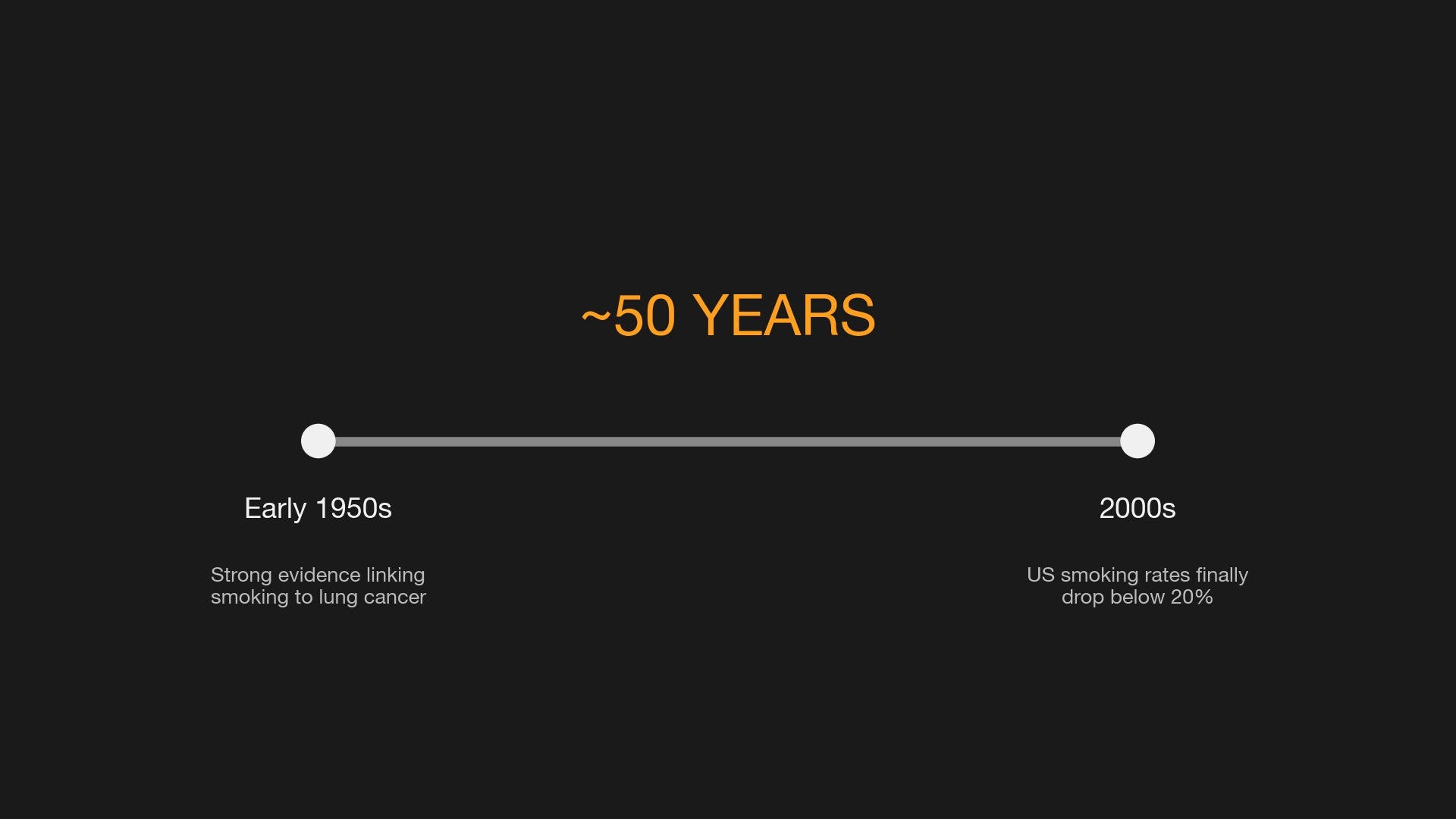
By the early 1950s, there was strong evidence that smoking causes lung cancer. The tobacco industry’s response wasn’t to accept the science. It was to fight it. They funded competing studies, highlighted uncertainty and repeated the narrative that “the science wasn’t settled” until it became the story. They didn’t need to prove cigarettes were safe. They just needed to make sure nothing ever felt conclusive, so they could keep selling.
That manufactured doubt slowed everything down. Scientists spent years re-proving what earlier studies already showed. Regulators couldn’t act because the “science wasn’t settled.” Consumers heard conflicting information and defaulted to doing nothing. Smoking rates stayed above 40% in the US for years. They didn’t drop below 20% until the 2000s. That’s a 50-year gap between the science being clear and people changing their behavior.
Science, even when it works perfectly, is too slow to protect you in real time. And industries with billions at stake have every incentive to make it slower.
Why regulation isn’t the answer
So if science is slow, shouldn’t the government step in? If consumers can’t assess safety and manufacturers won’t self-correct, just have an agency test everything, mandate compliance, and the problem goes away, right?
It sounds airtight, but it fails in predictable, structural ways.
1. Regulatory capture
In 1971, economist George Stigler published The Theory of Economic Regulation, arguing that regulation is consistently acquired by the industries it’s supposed to oversee and designed to benefit them. Not sometimes. As a rule. The logic is simple: industries have concentrated financial stakes in regulatory outcomes. Consumers have diffuse, spread-out interests. The people with the most to lose show up. Everyone else doesn’t.
Industries employ armies of lobbyists, donate to campaigns, offer post-government jobs to regulators, and fund the research that shapes evidentiary standards. Over time, the agency’s decisions drift toward industry preferences, not because anyone is cartoonishly corrupt, but because the information, the access, and the incentives all flow in one direction.
Economist Bruce Yandle called this the Bootleggers and Baptists framework. During Prohibition, Baptists pushed for alcohol bans on moral grounds. Bootleggers quietly supported them because the bans eliminated legal competition. Both wanted the same policy, for completely different reasons.
The same dynamic plays out in product safety regulation. The people with the strongest opinions about how a chemical should be regulated are the ones selling it. And over enough time, the line between regulator and regulated gets hard to see.
2. Regulation is slow
New chemicals enter commerce faster than any agency can evaluate them. New formulations, new combinations, new manufacturing processes — the pace is accelerating and regulation isn’t built for speed.
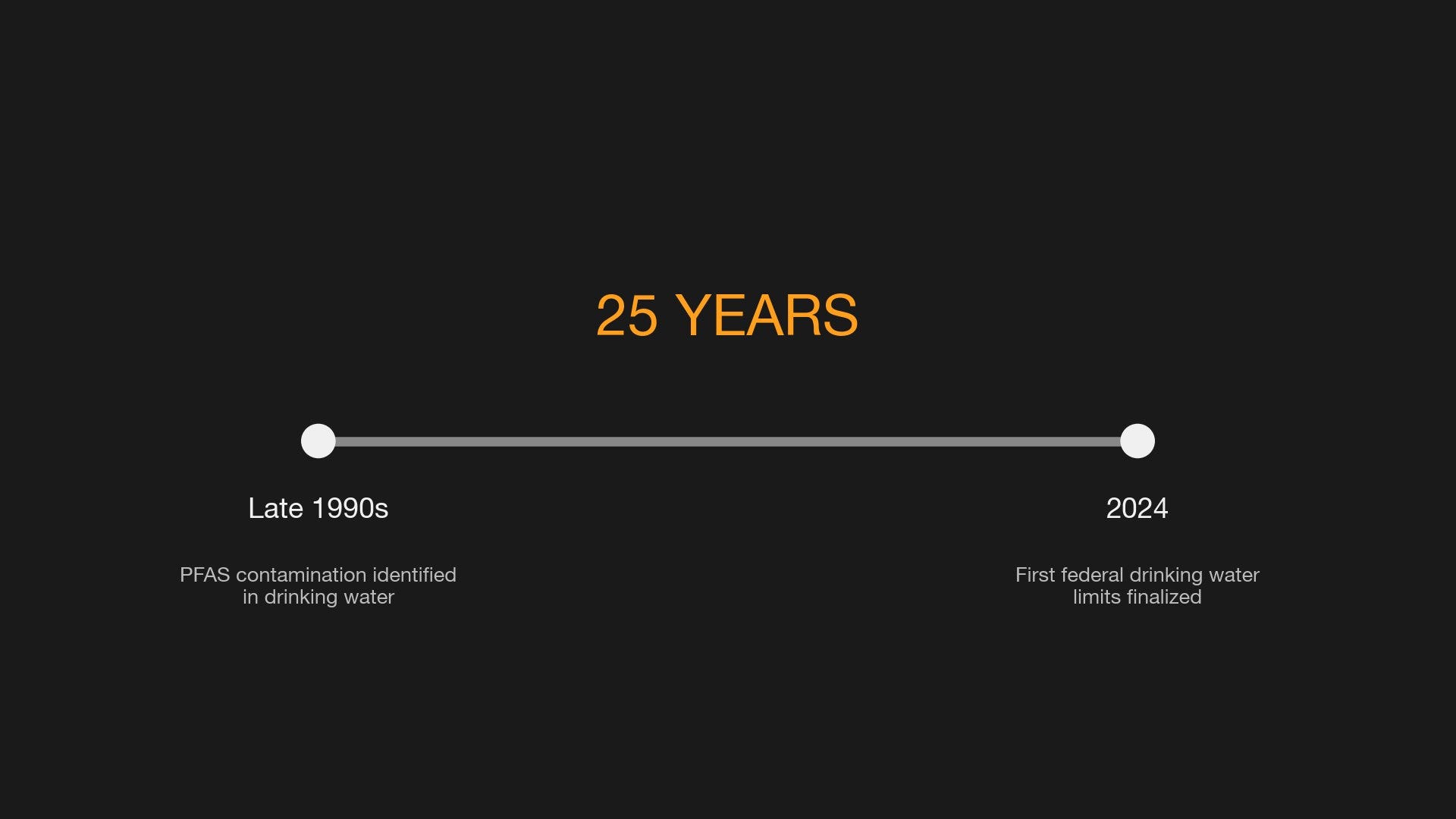
The EPA’s formal risk evaluation process for a single chemical takes roughly three to seven years, and that’s after the chemical has been selected for review from a backlog of thousands. PFAS contamination was first identified in drinking water in the late 1990s. The first federal drinking water limits weren’t finalized until 2024. That’s a quarter century between “we know this is a problem” and “here’s the rule.”
A system that takes decades to act on a known threat can’t meaningfully protect you from a market that introduces new formulations continuously.
3. The task is too big.
The FDA, CPSC, and EPA operate with limited budgets, limited staff, and a mandate that covers tens of thousands of synthetic chemicals, with new ones introduced constantly. No centralized institution can test everything, monitor manufacturing across thousands of facilities, and track harms that take decades to show up.
What agencies actually do is set thresholds for known hazards and assume everything else is safe until proven otherwise. The alternative is the precautionary principle, a regulatory philosophy where when there’s “credible” reason to think something might cause harm, you don’t wait for absolute proof before acting. Protect people first.
This sounds logical, but applied broadly, it has real problems.
Slower innovation, higher costs and it can be used to justify almost anything. Every action has uncertainty, so “be cautious” on its own doesn’t actually tell you what to do.
And who decides what a “credible reason” is?
In practice, it’s still regulators. The same ones who are already overwhelmed, and as we just covered, highly influenced by the industries they’re supposed to regulate.
So you’re left with two options: a system that assumes everything is safe, or a system that can’t decide what isn’t. Either way, you’re on your own.
The good news
The precautionary principle doesn’t work as regulation. But it works perfectly as a personal philosophy.
When a regulator tries to apply precaution across an entire economy, they run into all the problems we just covered: who defines “credible risk,” slowed innovation, increased prices, and regulatory capture. But when you apply precaution in your own home, those problems disappear. You’re not banning anything. You’re not slowing down innovation. You’re just picking the shampoo that doesn’t have the questionable ingredient when there’s one right next to it that works just as well.
Do we really need non-stick pans coated in PFAS, a chemical linked to cancer, or are stainless steel pans non-stick if you use them right?
Do we really need plug-in air fresheners pumping synthetic fragrance chemicals into our lungs, or does a soy candle with essential oils make the room smell just as good?
Do we really need couches treated with flame retardants linked to thyroid disease and fertility problems, or can we use natural alternatives like wool, which are inherently flame resistant?
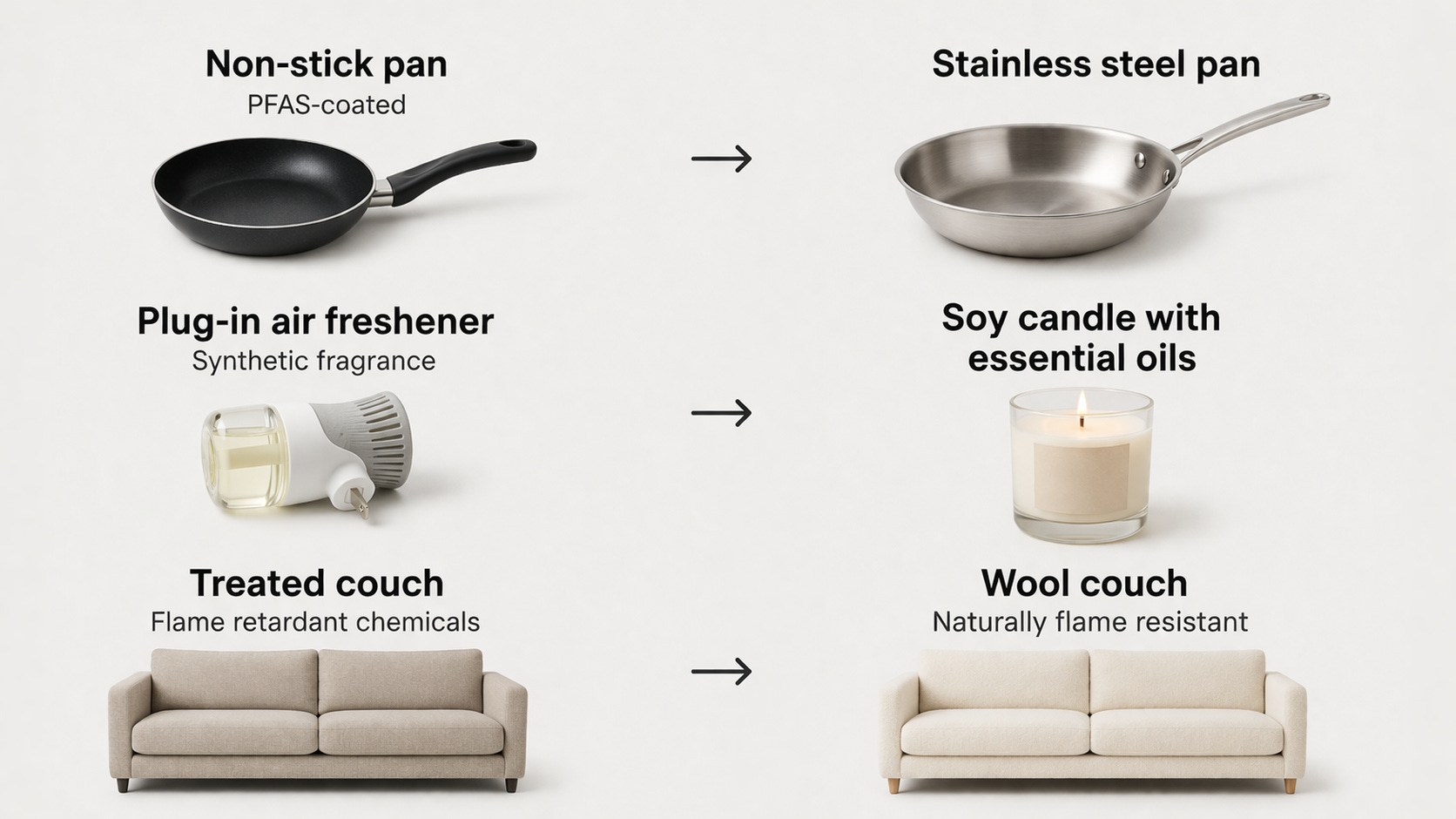
You’re not giving anything up. You’re not sacrificing quality. You’re just picking the option that doesn’t come with the uncertainty. Once you see it that way, the decision isn’t really a decision at all. It’s obvious.
Your home has hundreds, sometimes thousands of products. Shampoo, cookware, mattresses, candles, bath linens, clothing, kids’ pajamas. Every category has its own safety considerations, its own science, its own brands making claims. What matters in a sunscreen is completely different from what matters in a mattress. Translating all of that into “what should I get rid of, then what should I replace it with?” for an entire home is a massive undertaking.
Nobody has time for that.
People already want healthier homes and they’d switch tomorrow if they knew what to switch to. The information technically exists, but it’s buried in research papers, scattered across blogs, locked behind jargon. But no one with a job and kids and a life has time to piece it together for every product in their house.
When that information becomes accessible — actually usable, not just theoretically available — “vote with your wallet” starts to mean something. Not as a slogan, but as a real market force that doesn’t depend on regulators who can’t keep up or agencies that have already been captured.
That’s the problem worth solving.
Conclusion
I’m working on this problem with my company Welpr.
The goal isn’t to lobby for regulation. The goal is to build tools that give people the information they need to create healthy homes and actually vote with their wallets.
Your home should be a sanctuary that supports the biology living inside it, not one that’s quietly poisoning that biology. Safer products already exist. The science is there. The only thing missing is a way to connect the two.
It shouldn’t be hard to be healthy.